Book Review: Kubernetes for Generative AI Solutions
-
 Gineesh Madapparambath
- Books, Kubernetes, Ai, Generative ai
- January 11, 2026
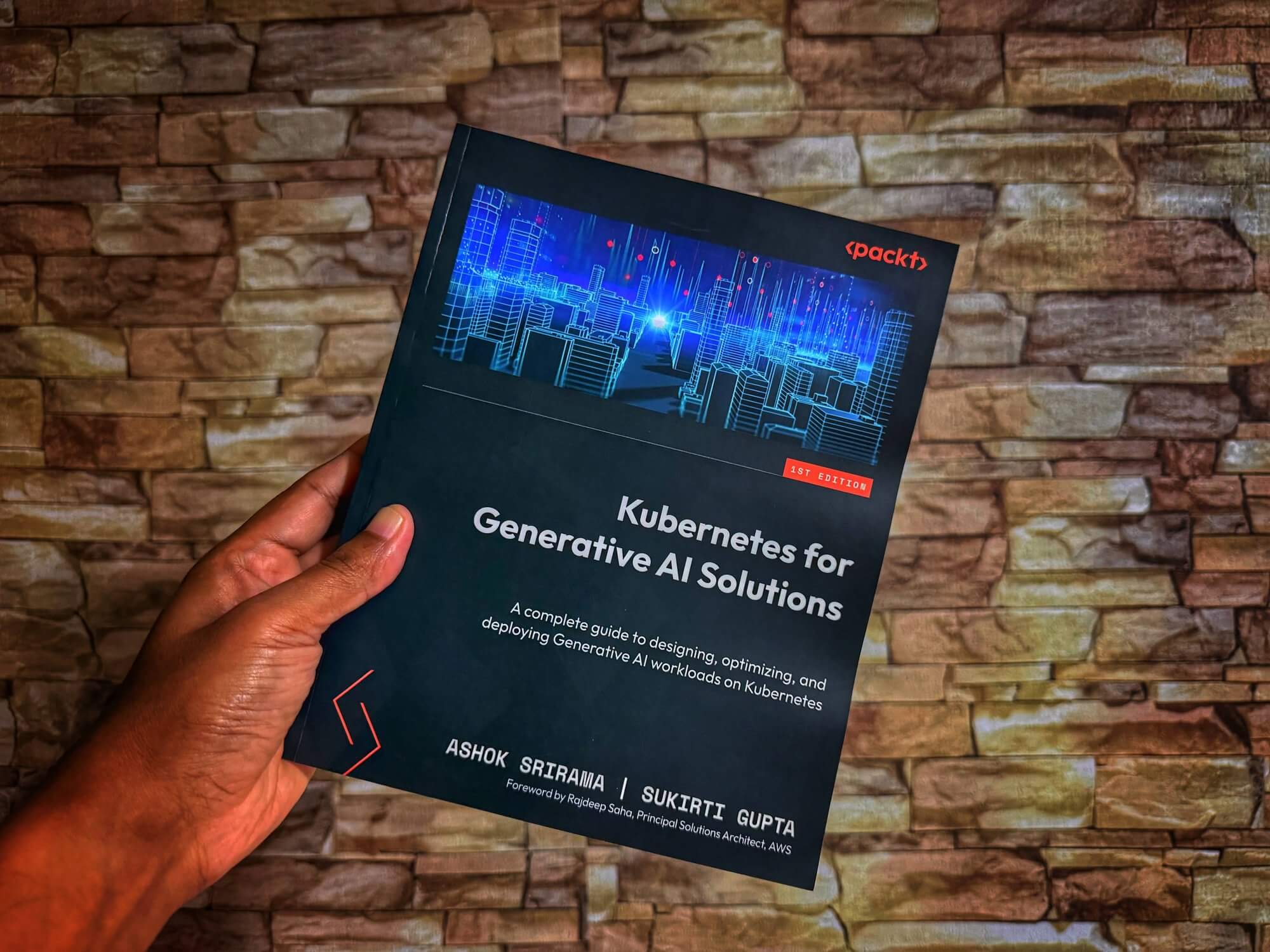
I finally finished reading Kubernetes for Generative AI Solutions by Ashok Srirama and Sukirti Gupta. It honestly took me some time to complete this one, but I used my travel time well, so it worked out nicely.
If you are trying to understand how GenAI workloads can be designed and operated on Kubernetes, this book is a solid guide.
The book starts with the fundamentals and clears up key terms like AI, Machine Learning, and Deep Learning, along with how these areas evolved over time. It also walks through the history and some of the internal architecture basics of AI/ML. If you are new to the AI/ML world, do not skip Part 1, because that foundation makes the later chapters much easier to understand.
The Kubernetes coverage in this book is flexible, depending on your background. It includes Kubernetes-focused chapters that explain the basics and even guide you through setting up your first Kubernetes cluster. If you’re already comfortable with Kubernetes, you can skim or skip those sections, but if you’re learning Kubernetes along with AI, the book gives enough guidance to get you started before moving into GenAI workloads.
One thing I really appreciated is that the authors spend a good amount of time covering AI/ML core concepts and tools before jumping into “let’s run this on Kubernetes”. That foundation matters a lot, because without it, many people end up just copying YAML manifests and deploying things without really understanding what the AI workload needs or how it behaves in real environments.
One part I really enjoyed in this book is how clearly it explains deploying AI applications on Kubernetes. It doesn’t stop at just running a workload, but shows how to think about operating it properly in a cluster.
The scaling chapters are especially useful, and they cover real Kubernetes scaling options like HPA, VPA, KEDA, and the Cluster Autoscaler. If you want to run AI workloads beyond a laptop setup and make it work in a real environment, this section will help a lot.
Running AI workloads can get expensive really fast, and I liked that the book doesn’t ignore that reality. It includes dedicated sections on cost optimization while running AI workloads on Kubernetes, which is super useful if you’re planning to move beyond a small demo setup.
It also covers important production best practices like Kubernetes networking and security. These are the kinds of topics many people learn only after facing issues in real environments, so it’s great to see them explained clearly in the book.
The final part of the book brings everything together from a real production angle. It moves beyond just deploying GenAI workloads and focuses on what it takes to run them properly at scale. The chapters cover GenAIOps (data management and automation pipelines), observability for getting visibility into GenAI workloads on Kubernetes, and high availability and disaster recovery planning for reliability. It ends with a wrap-up on GenAI coding assistants and a good set of further reading suggestions, which makes the closing section practical and nicely rounded.
Thanks to Abin and Packt for sharing a copy of this book with me 🙏
📚 Get your copy here.
Gineesh Madapparambath
Gineesh Madapparambath is the founder of techbeatly. He is the co-author of The Kubernetes Bible, Second Edition and the author of Ansible for Real Life Automation. He has worked as a Systems Engineer, Automation Specialist, and content author. His primary focus is on Ansible Automation, Containerisation (OpenShift & Kubernetes), and Infrastructure as Code (Terraform). (Read more: iamgini.com)
Note
Disclaimer: The views expressed and the content shared in all published articles on this website are solely those of the respective authors, and they do not necessarily reflect the views of the author’s employer or the techbeatly platform. We strive to ensure the accuracy and validity of the content published on our website. However, we cannot guarantee the absolute correctness or completeness of the information provided. It is the responsibility of the readers and users of this website to verify the accuracy and appropriateness of any information or opinions expressed within the articles. If you come across any content that you believe to be incorrect or invalid, please contact us immediately so that we can address the issue promptly.