How to Become a Red Hat Certified Architect (RHCA)
-
 Gineesh Madapparambath
- Red hat, Certifications, Linux, Automation, Kubernetes
- December 24, 2025
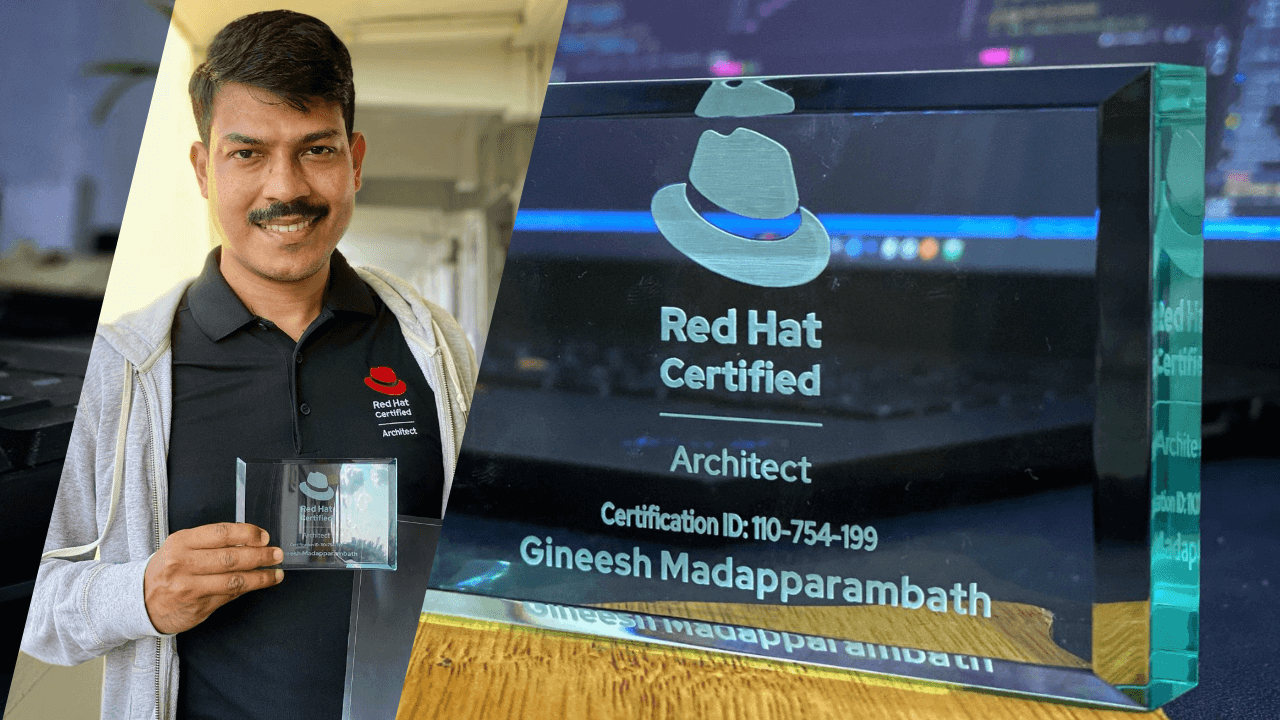
If you spend enough time working with Linux, automation, and platforms, the Red Hat certification path eventually becomes part of the conversation. Somewhere along that path sits RHCA. Not as a starting goal, and usually not as something people chase on day one, but as a natural outcome of years of hands-on work and steady learning.
This post breaks down what RHCA really is, why it matters, how Red Hat structures it, and how people actually end up there. I’ll also share how it happened for me with some useful information below.
For those who are curious about the Red Hat remote exam option, I highly recommend checking out the guide on techbeatly where I have included insights and information on how to navigate the Red Hat Remote Exam process.
My starting point: RHCE in 2007
My Red Hat journey began in June 2007 with RHCE on RHEL 4. That exam was tough in the best possible way. There were no multiple-choice questions, no theory-heavy sections, and no room to hide behind memorised answers. You were dropped into a broken RHEL system and expected to fix it, troubleshoot boot issues, recover services, and bring the system back to a working state under time pressure.
That experience gave me more than a certification. It built a strong foundation in how Linux systems actually behave when things go wrong, and it gave me real confidence. Confidence that I could debug production issues, confidence that I understood systems beyond commands, and confidence that I could stay calm when something broke. That mindset stayed with me throughout my career.
What RHCA actually is
RHCA, or Red Hat Certified Architect, is the highest-level certification offered by Red Hat. It is not a single exam and it is not tied to one narrow skill. RHCA is earned by completing a set of advanced, hands-on Red Hat certifications that align with a chosen track or area of expertise.
The program is deliberately flexible. Red Hat designs RHCA so it can adapt to different roles, interests, and organisational needs. The idea is simple: organisations using Red Hat technologies, and the professionals working with them, are best placed to decide which skills matter most. RHCA reflects that reality by allowing candidates to mix and match certifications rather than forcing everyone down the same path.
How RHCA happened for me (without planning it)
I didn’t wake up one day and decide to plan an RHCA journey. Instead, I had a simple habit for many years. I tried to take one Red Hat exam every three to four months, usually around areas I was actively working in, such as Ansible or OpenShift. The goal was continuous learning, not collecting badges.
Over time, those certifications quietly added up. One day, I received a notification saying I had completed the required number of exams for RHCA. That moment brought unexpected happiness. There was no last-minute rush, no stressful master plan, just the realisation that consistent learning compounds over time.
Why RHCA matters
RHCA is not about status or titles. Its value comes from depth, breadth, and trust. In the industry, RHCA signals that someone has gone through multiple advanced, practical lab exams and demonstrated real skills across platforms, automation, or applications. These are not exams you pass by memorising answers. You pass them by understanding systems and solving real problems.
RHCA also represents architectural thinking. People with this credential are often trusted to design solutions, think in trade-offs, and understand how different layers of a platform interact. From a career perspective, RHCA carries weight in consulting roles, architecture discussions, leadership positions, and customer-facing technical work. There is also a quieter benefit that matters just as much: confidence. After enough Red Hat lab exams, production incidents feel less intimidating because you have already trained yourself to think clearly in broken environments.
RHCA program structure and flexibility
The RHCA program requirements are intentionally flexible and can adapt to a wide range of interests and needs. Red Hat provides recommended combinations of certifications to help guide candidates, recruiters, and managers, but these combinations are not mandatory paths. They are suggestions based on how technologies are commonly used in the field.
These recommended combinations can change over time as technologies evolve. Pursuing a specific combination does not create a separate or special certification. All listed certifications can be earned independently, whether or not a candidate already holds RHCE, RHCEMD, RHCCD, or none of those credentials.
For developers, Red Hat notes that becoming a Red Hat Certified Specialist in Enterprise Microservices Development requires an RHCCD credential.
To learn more about the different tracks and certifications, check out this official RHCA page.
Guidance for RHCEMDs and RHCCDs (Enterprise Applications track)
RHCA is a strong fit for Red Hat Certified Enterprise Microservices Developers (RHCEMDs) and Red Hat Certified Cloud-native Developers (RHCCDs) who want to demonstrate broader and deeper expertise across middleware and application platforms. Candidates in this category can choose any combination within the Enterprise Applications track.
Those who earn five or more credentials from the developer list become Red Hat Certified Architects in Enterprise Applications. Red Hat strongly recommends, though does not require, that candidates earn both Red Hat Certified Specialist in OpenShift Application Development and Red Hat Certified Specialist in Enterprise Application Server Administration. Most recommended combinations assume these two certifications have already been earned.
Within this track, Red Hat highlights two major focus areas. The application acceleration and integration program focuses on speeding up development cycles and improving how applications and services are integrated and deployed, with certifications such as Cloud-native Integration and Containers. The DevOps, containers, and OpenShift program focuses on CI/CD, automation, and platform-driven development, covering Ansible, configuration management, API management, containers, and advanced automation practices.
RHCEs and the Infrastructure track
For Red Hat Certified Engineers who want to demonstrate broader and deeper expertise across Red Hat Enterprise Linux and related technologies, RHCA in Infrastructure is a natural fit. RHCEs can choose any combination of certifications from the infrastructure-focused list. Earning five or more certifications from the system administrator list qualifies a candidate as a Red Hat Certified Architect in Infrastructure.
There is also a higher-level designation. Earning six credentials beyond the base credential results in RHCA Level II status, as long as all certifications remain current. If certifications expire, the RHCA level adjusts accordingly, and eventually the RHCA status itself no longer applies if too many credentials become non-current.
Optional depth areas within RHCA
Red Hat outlines several optional depth areas to help candidates focus their learning. The open hybrid cloud program centres on flexibility, agility, and cost control across on-premises and cloud environments. Certifications here include OpenShift Administration, Cloud Infrastructure, Ceph, OpenShift Automation, Containers, and ROSA.
The DevOps, containers, and OpenShift program for infrastructure roles emphasises automation, CI/CD, and modern application delivery using OpenShift and Ansible. Candidates combine OpenShift, API management, automation, containers, data foundation, multicluster management, and automation platform certifications.
For telecom professionals, the Telco Cloud program focuses on SDN, NFV, OpenStack, and platform technologies relevant to modern telecommunications environments. Linux mastery is another depth area, aimed at engineers who want to focus deeply on Linux itself, covering diagnostics, performance tuning, security, identity management, high availability, and systems management.
RHCA exams and maintaining status
To attain and maintain RHCA status, RHCEs must pass at least five approved specialist exams and keep those certifications current. These exams span containers, cloud infrastructure, OpenShift administration, automation, Linux performance and troubleshooting, security, identity management, multicluster management, and more.
Similarly, RHCEMDs and RHCCDs must pass at least five approved exams aligned with application development, OpenShift, automation, API management, and microservices. Some older exams in both tracks are retired, but Red Hat continues to evolve the list as technologies change.
Final thoughts
RHCA is not a beginner goal and it is rarely something people achieve overnight. It is the result of years of hands-on work, steady curiosity, and consistent learning. In my case, it started with a broken RHEL 4 system in 2007, continued through years of automation and platform work, and arrived quietly when I least expected it.
If you are already on the Red Hat path, focus on understanding systems deeply and learning continuously. RHCA tends to follow naturally. If you want, I can break this down further by track, map RHCA paths specifically for Ansible or OpenShift professionals, or share practical strategies for preparing for Red Hat lab exams.
Gineesh Madapparambath
Gineesh Madapparambath is the founder of techbeatly. He is the co-author of The Kubernetes Bible, Second Edition and the author of Ansible for Real Life Automation. He has worked as a Systems Engineer, Automation Specialist, and content author. His primary focus is on Ansible Automation, Containerisation (OpenShift & Kubernetes), and Infrastructure as Code (Terraform). (Read more: iamgini.com)
Note
Disclaimer: The views expressed and the content shared in all published articles on this website are solely those of the respective authors, and they do not necessarily reflect the views of the author’s employer or the techbeatly platform. We strive to ensure the accuracy and validity of the content published on our website. However, we cannot guarantee the absolute correctness or completeness of the information provided. It is the responsibility of the readers and users of this website to verify the accuracy and appropriateness of any information or opinions expressed within the articles. If you come across any content that you believe to be incorrect or invalid, please contact us immediately so that we can address the issue promptly.