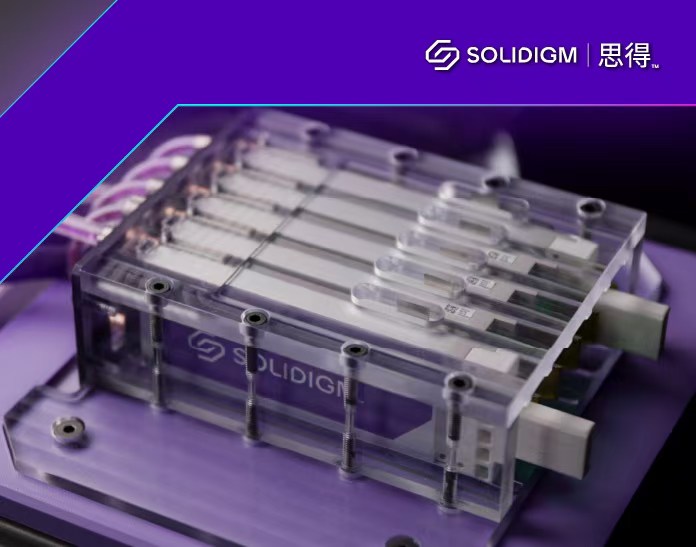
As the power density of AI and HPC systems continues to rise, liquid cooling is moving from a high-end option to a default architecture. GPUs and CPUs have already pioneered this transition, with storage (SSDs) emerging as the next critical component.
It’s not about whether SSDs are three seconds faster than other types of storage, but about a more systemic problem. When compute fully enters the era of liquid cooling, what happens to performance, energy consumption, and ROI if we continue to use air-cooled SSDs?
Read on to learn how Solidigm solved this system-wide constraint with an engineered liquid-cooled SSD solution.
The Problem: SSD Thermal Behavior Is Becoming a System Bottleneck
The evolution of eSSDs is driving up the thermal and power pressure of storage
Data storage is facing a serious imbalance. As the PCIe protocol advances from 4.0 to 7.0, power consumption of SSDs per drive has jumped from 25W to 60W. In AI architectures in which the computing nodes are fully liquid-cooled, storage heat dissipation is still stuck in the old era of “blowing air.” Between this leap in SSD power density and outdated heat dissipation methods, an obvious generational mismatch has formed, restricting the reliability boundary of the entire system.
eSSD temperature is directly triggering system failure rather than slowly affecting performance.
| No Throttle | Threshold 1 | Threshold 2 | |
|---|---|---|---|
| SSD Temperature | <77°C | ≥77°C | ≥79°C |
| SSD Performance | 100% | ~58% | <1% |
Table 1. SSD temperature and performance thresholds
What does this mean? Once it reaches the upper thermal limit, the data channel is almost completely cut off.
In AI systems, this behavior is not just a local problem, but one that can be quickly amplified.
eSSD thermal runaway amplifies the effects along the system path
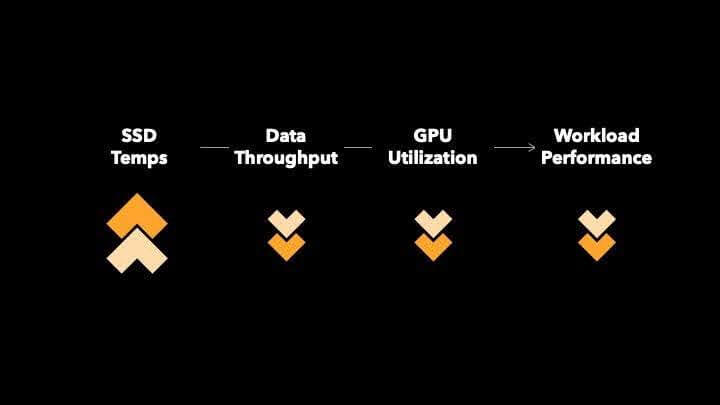
The result is not simply that “SSDs are slower,” but rather that the most expensive GPUs in the AI server start idling.
Traditional air-cooled SSDs are no longer suitable for AI systems
Physical and economic limits of air cooling on high-power SSDs
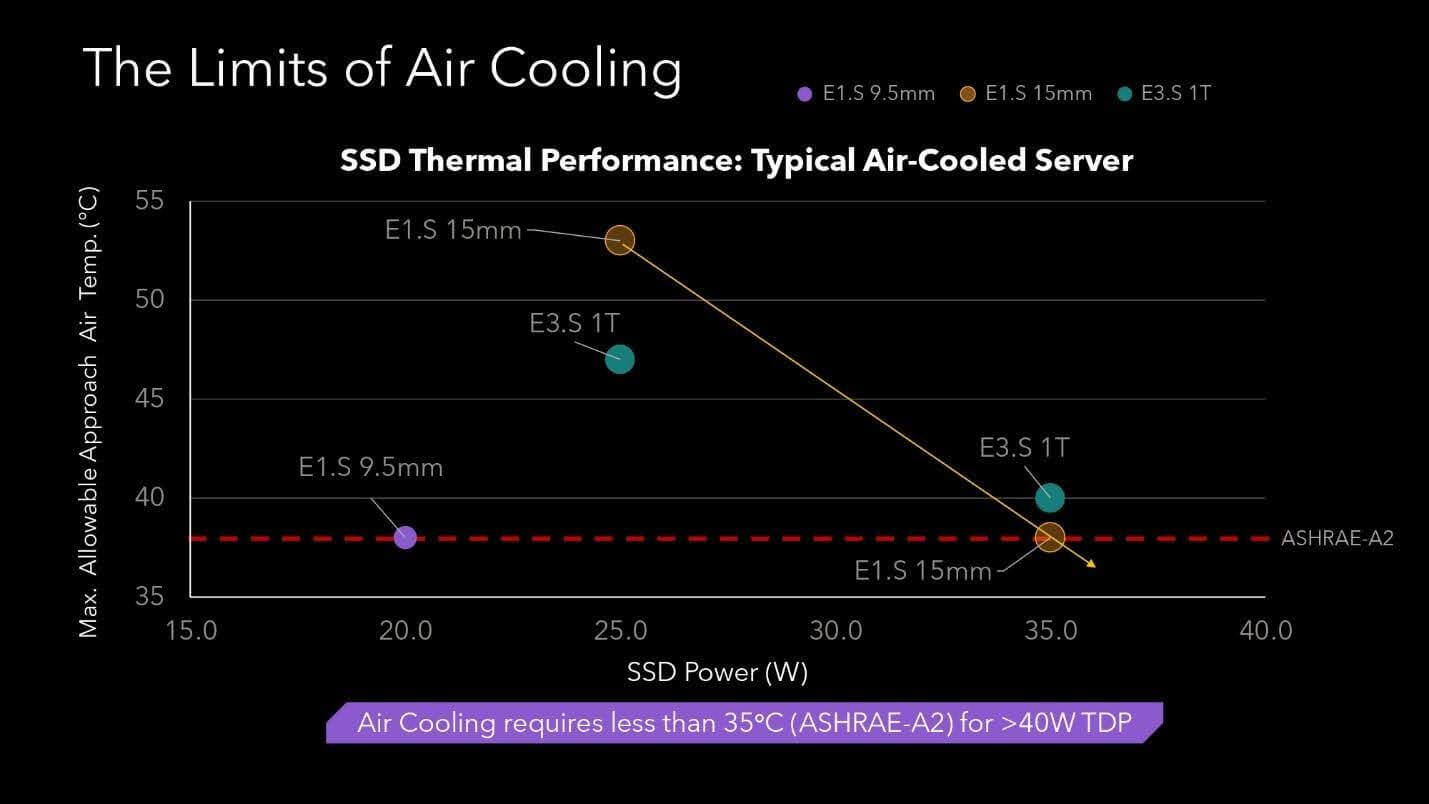
When SSD power consumption moves toward 40W to 60W:
- Air inlet conditions below 35°C are required
- Higher airflow and more fans are needed
- Energy consumption and noise increase significantly
This not only increases cooling costs but also limits system density.
GPU/CPU liquid cooling makes the environment of air-cooled SSDs even worse
When the GPU and CPU switch to liquid cooling:
- The internal air ducts of the server are redesigned
- SSDs tend to be in a poor position for heat dissipation
The result: SSDs are among the most vulnerable components to heat-related impacts in the most expensive AI servers.
Challenges and Design Considerations for Liquid-Cooled SSDs
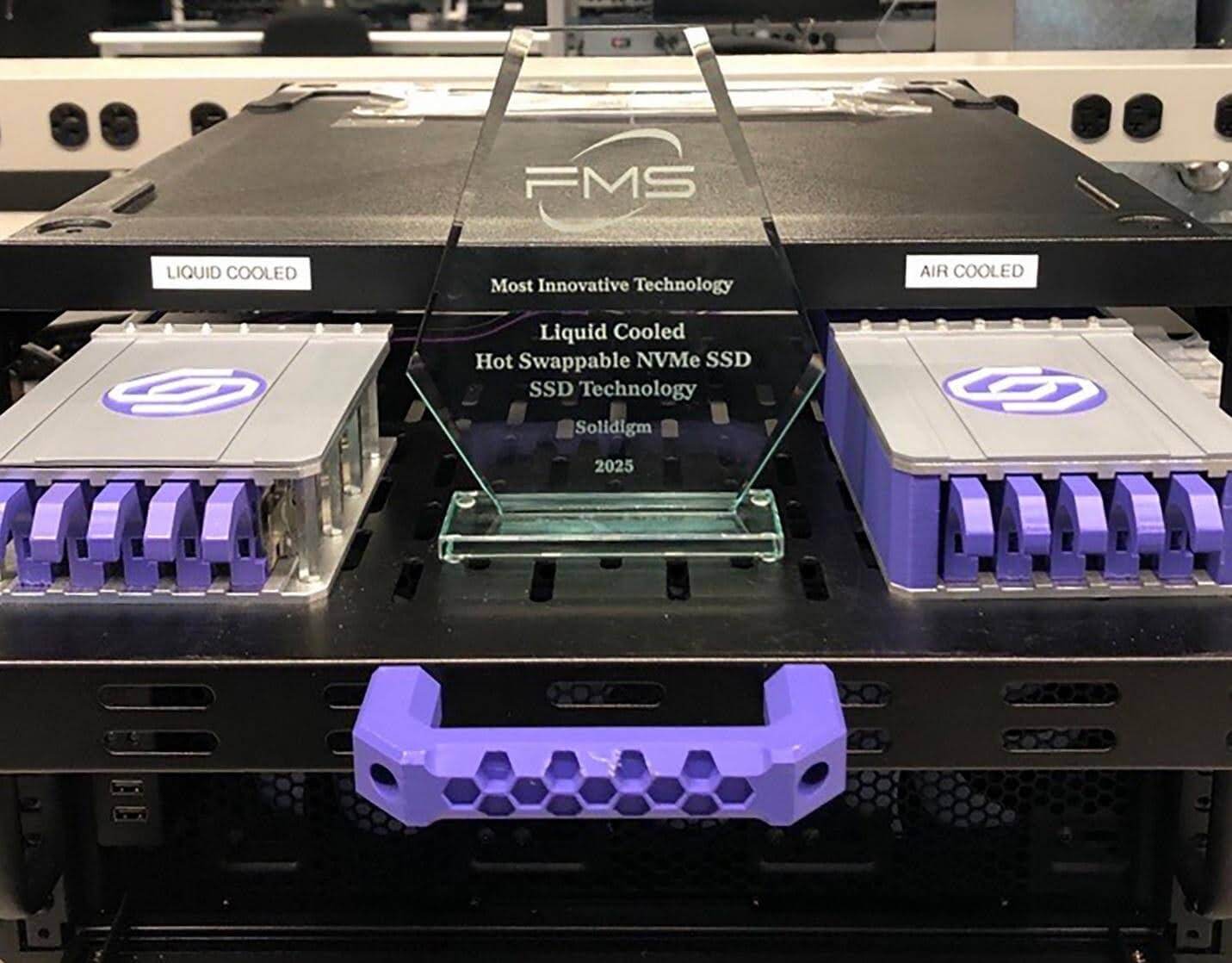
The core challenge of liquid-cooled SSDs is not about attaching a cold plate to the drive. Instead, it lies in:
- Addressing the fundamental thermal characteristics of dual-sided heat generation
- Enabling hot-plug capability in liquid-cooled environments
- Defining a viable path toward standardization
Ultimately, this requires a system-level rethinking of liquid-cooled storage architecture.
Single active cooling for dual-sided SSD thermal management
In conventional E1.S SSDs, the controller, DRAM, and NAND components are distributed across both sides of the printed circuit board (PCB). Attaching a cold plate to only one side of the drive leaves the opposite side as a thermal blind spot, creating an inherent limitation in heat removal.
Addressing this challenge requires architectural changes to pull heat from both sides of the PCB using a single cold plate. This not only improves the SSD thermal performance but also increases system level heat recovery from liquid.
Hot-swappable liquid cold plate solution
In real-world operations, liquid cooling introduces a fundamental tension. Applying sufficient pressure between the cold plate and the SSD is necessary for effective thermal conduction, but overly tight coupling eliminates hot-plug capability.
By introducing a precision-engineered mechanism, it is possible to maintain firm physical contact between the SSD and the cold plate for optimal heat transfer while still allowing instantaneous release during maintenance. This enables hot-plug and serviceability without system shutdown or coolant disconnection, achieving an operational experience comparable to air-cooled environments.
Sustaining a high level of serviceability is critical. Without it, liquid-cooled SSDs risk becoming impractical for data center deployment instead of a viable production solution.
Standardization: A prerequisite for scalable deployment
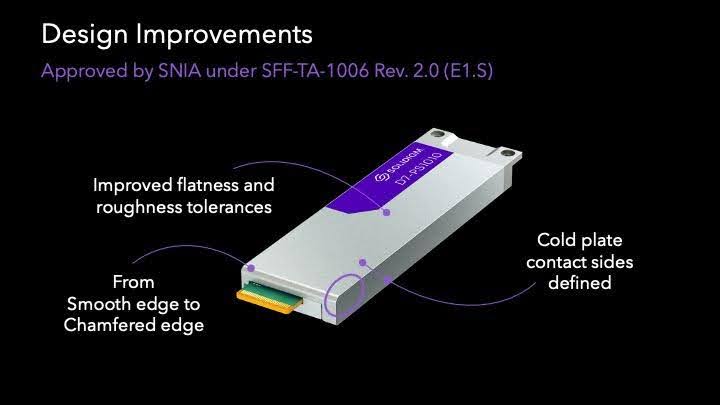
Standardizing liquid-cooled SSDs is a critical step toward enabling high-density, energy-efficient, fully liquid-cooled data center architectures. Leading industry players are actively driving the development and adoption of formal specifications. Solidigm, in collaboration with SNIA, has released the SFF TA-1006 (Rev 2.0) specification, which defines the liquid-cooled implementation for the E1.S form factor and marks the transition from proprietary, custom-built solutions to open, reusable industry standards.
The specification tightly defines parameters such as cold plate contact area, surface flatness, and roughness tolerances to ensure predictable and repeatable thermal performance. In addition, features such as chamfered edge design address mechanical insertion and removal challenges under high contact pressure conditions.
The core value of this effort lies in transforming liquid-cooled SSDs from case-by-case custom engineering into standardized, mass-deployable components - establishing a solid foundation for industrial-scale adoption in data centers.
Open Data Center Committee (ODCC) partnership
Looking ahead, ecosystem-level collaboration will be essential to accelerating the standardization and large-scale adoption of liquid-cooling technologies in next-generation data centers. Founded in 2014 the ODCC, has become a leading open platform in China’s data center industry. ODCC has actively promoted technical standardization and innovation across servers, networking, liquid cooling, edge infrastructure, and data center facilities. It has established a wide range of mature open technical specifications.
By working closely with ODCC, enterprises can better align their liquid-cooling products and solutions with advanced industry standards, gain access to timely technical insights, and benefit from ODCC’s ecosystem influence and platform credibility. Such collaboration can help accelerate market acceptance, improve solution trustworthiness, and support the broader deployment of efficient, reliable, and sustainable liquid-cooling infrastructure.
By publishing this article via ODCC channel, ODCC is helping to share insights from Solidigm into industry-leading liquid-cooled SSD design with the data center ecosystem increasingly focused on scalable, efficient liquid-cooling adoption.
From Liquid-Cooled SSDs to the Natural Outcomes of System Design and ROI
Through liquid cooling, SSDs can operate in the non-throttling range for extended periods, ensuring a continuous and stable data supply. This stability directly eliminates GPU idle time (wait states) caused by storage-side cooling bottlenecks which allows compute resources to remain fully utilized. From a system perspective, improved ROI is not a separate objective, but a natural outcome of the physical alignment between the storage architecture and computing requirements.
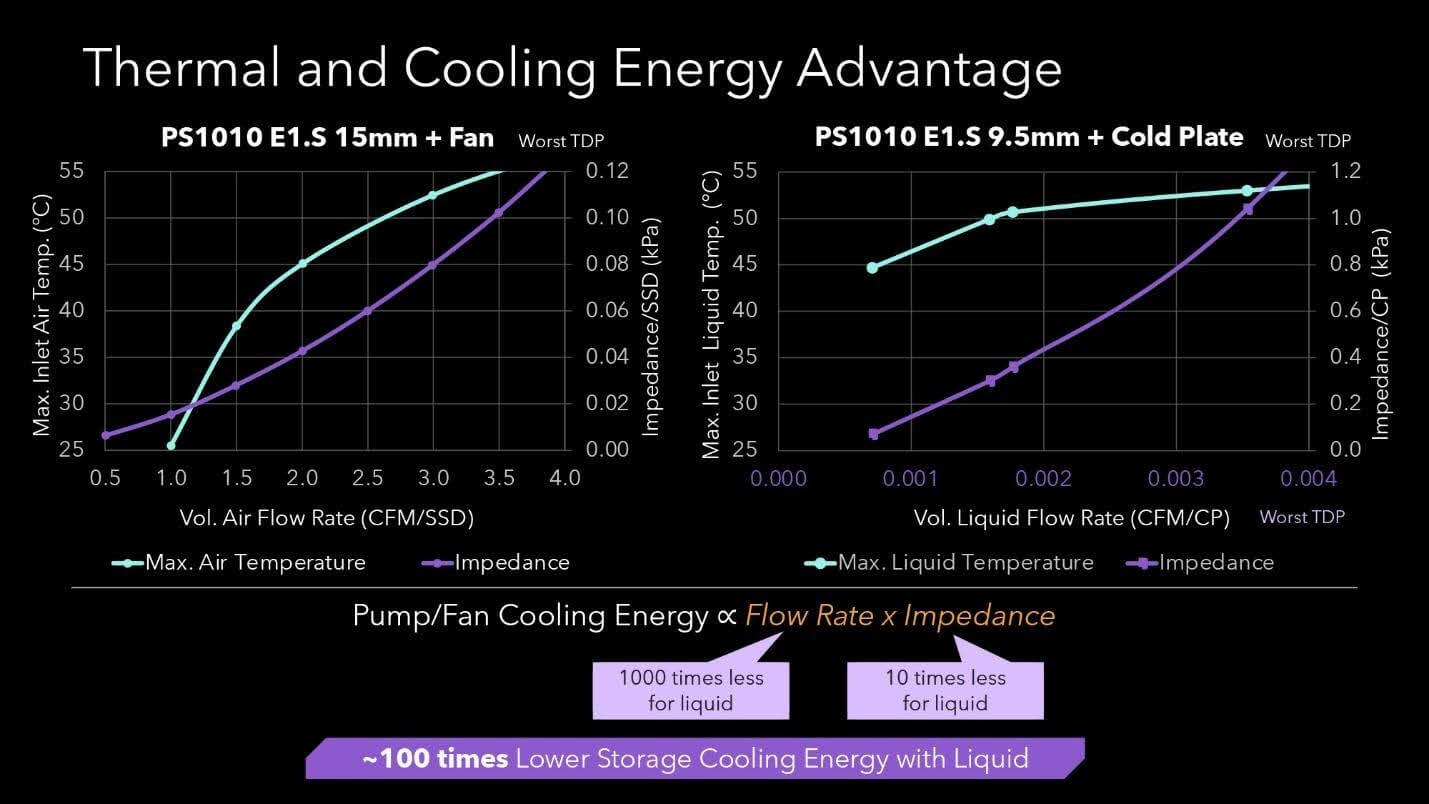
At the server level - and even across the entire data center - liquid-cooled SSDs deliver not just localized optimization, but overall improvement in system efficiency. Compared with traditional methods, liquid cooling requires much less energy usage than air cooling under the same heat dissipation requirements, and when combined with a higher-density, fanless design, it greatly reduces rack space needs and the complexity of ongoing operations and maintenance. This architectural streamlining translates directly into meaningful improvements in data center energy efficiency, creating gains from the component level all the way to the overall infrastructure.
Liquid-Cooled Storage: The Underlying Closed Loop of AI Systems
In today’s AI architectures, the GPU is responsible for delivering compute, while storage is responsible for maintaining data supply. Your cooling solution determines whether these two components can cooperate continuously with stability in real-world deployments. Solidigm liquid-cooled SSD solutions are designed not merely to cool a component, but rather to bridge the generational gap between computing and storage. Our approach allows the entire AI system to achieve a stable physical balance between extreme performance, overall energy efficiency, and architectural consistency. When this deep system-level coupling is achieved, improved ROI is no longer a separate business metric, but an inevitable result of this technical balance.

The Desk
techbeatly is a platform to share knowledge on Cloud, DevOps, Infrastructure and Opensource. We are focusing on technology tracks like Automation, Artificial Intelligence, Containerisation, CI/CD, Infrastructure as Code etc. Subscribe to YouTube
Note
Disclaimer: The views expressed and the content shared in all published articles on this website are solely those of the respective authors, and they do not necessarily reflect the views of the author’s employer or the platform. We strive to ensure the accuracy and validity of the content published on our website. However, we cannot guarantee the absolute correctness or completeness of the information provided. It is the responsibility of the readers and users of this website to verify the accuracy and appropriateness of any information or opinions expressed within the articles. If you come across any content that you believe to be incorrect or invalid, please contact us immediately so that we can address the issue promptly.

 Editorial