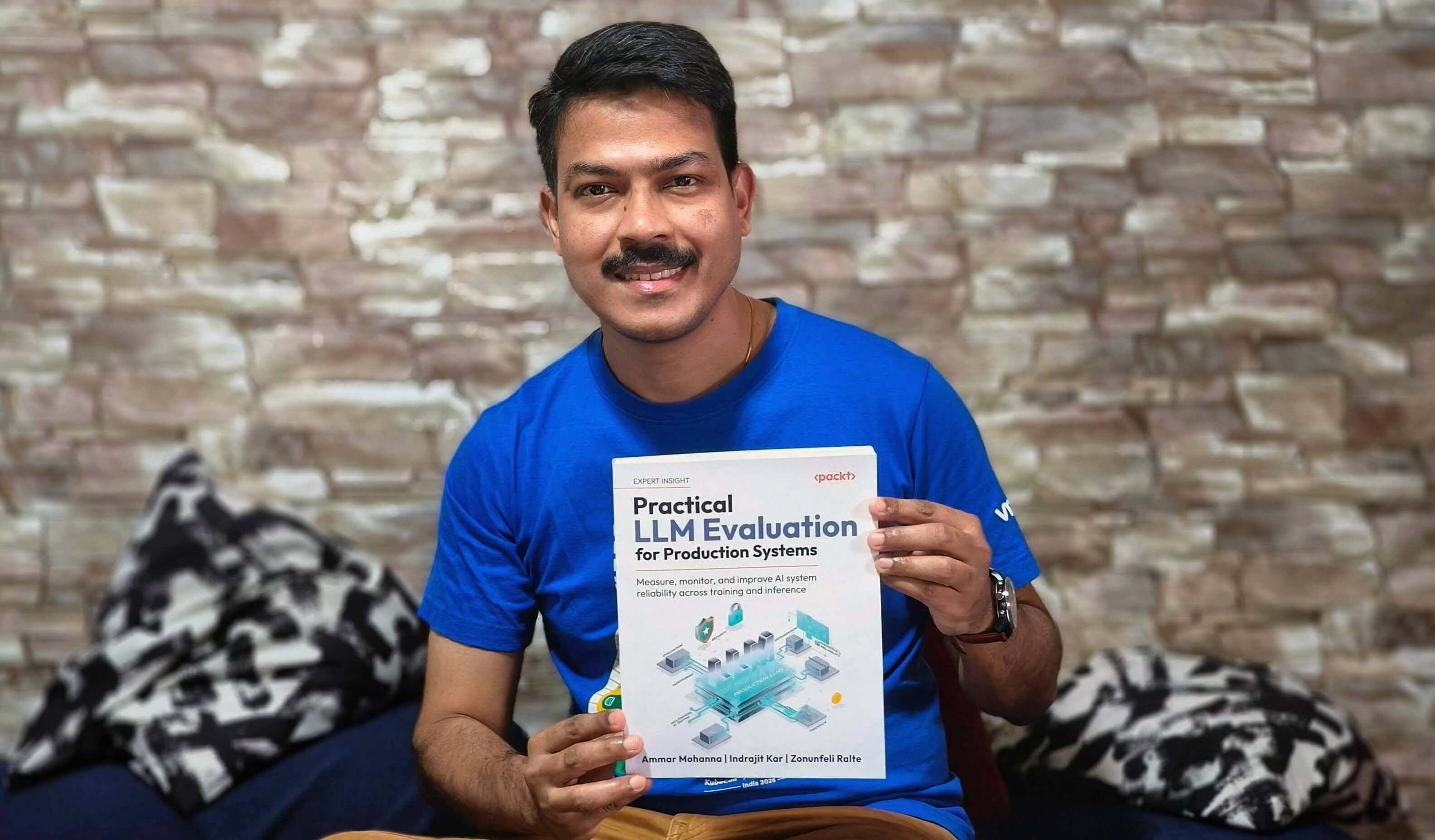
Authors: Ammar Mohanna, Indrajit Kar, Zonunfeli Ralte
Publisher: Packt
I picked up Practical LLM Evaluation for Production Systems because evaluation is one of those areas that everyone talks about but few resources cover in real depth. Most content out there stops at “use an LLM-as-a-judge” and calls it a day. This book goes a lot further.
It starts with the fundamentals of LLM evaluation: what it actually means to evaluate a production system, the primitives involved, evaluation logs, and how to build a shared vocabulary around evaluators, metrics, and thresholds. This foundation is solid enough that both someone new to the space and someone who has already run evaluation pipelines in production will get value from it.
I’ll be honest, there’s a lot of theory packed in here. It took me some real time to read through and digest, especially the chapters on training-time evaluation, statistical hygiene under nondeterminism, and the various evaluator types. It’s not a book you skim in an afternoon, but the depth is the point.
What I found genuinely useful is how the book separates training-time evaluation from inference-time control. It walks through data quality gates, leakage and contamination detection, instruction-tuning evaluation, and preference tuning trade-offs on the training side, then moves into prompt governance, output contracts, decoding stability, and safety controls as slice-based gates on the inference side. Guardrails and runtime safety get proper treatment rather than a passing mention.
The book doesn’t stop at text-only systems either. There’s solid coverage of vision-language models, cross-modal alignment, and evaluating multimodal conversational LLMs end to end, from data quality through conversational outcome evaluation. It also goes into mixture-of-experts routing and reliability, and a full chapter on computer-using agent systems, which is a space that badly needed a structured evaluation approach.
One specific concept I really liked was the risk-weighted runtime evaluation pyramid for VLMs. It’s a clean way to reason about where to spend evaluation effort based on risk severity rather than treating every failure mode equally, and the book explains it well with supporting diagrams.
More generally, the authors are good at taking genuinely complicated topics and breaking them down with clear tables, charts, and data samples. That style carries through the whole book and makes the dense material easier to work through than it would otherwise be.
If you’re looking for a resource that goes beyond surface-level “how to eval your LLM” content and actually gets into real methodologies and practices for evaluating LLMs, VLMs, reasoning models, agents, and multimodal systems in production, this is a strong resource to have on the shelf.
Thanks to Nimisha / Packt for the book copy.

Gineesh Madapparambath
Gineesh Madapparambath is the founder of techbeatly. He is the co-author of The Kubernetes Bible, Second Edition and the author of Ansible for Real Life Automation. He has worked as a Systems Engineer, Automation Specialist, and content author. His primary focus is on AI, Ansible Automation, Containerization (OpenShift & Kubernetes), and Infrastructure as Code (Terraform). (Read more: gineesh.com)